The annual 7-Day Roguelike Challenge ended last month, and there were a whopping 25 finishers this year (out of 45 participants). You can find a list of all the finished entries here, at Rogue Temple. Cymon has also written reviews for all 25 games, which you can access here.
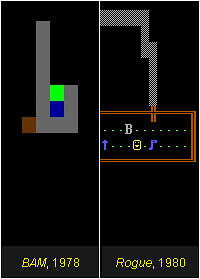
Shown above is Jeff Lait’s entry, Jacob’s Matrix, which is a really unique and fun roguelike. The game is turn-based, but you are racing against a real-time clock. There are some other neat twists, too, like the orientation of the map, which is always changing, and your ability to change classes at any time. Jeff is best known for his more traditional roguelike, Powder, although I enjoy his 7DRL’s more!
Are you tired of dying in the winter?
Tired of tree-hugging elves murdering over a simple wooden chair?
Tired of moody dwarfs striking in the workplace?
Do you try and try again to play Dwarf Fortress?
Do you say to yourself over and over, “Maybe next year,” or “If only the interface made sense”?
IF YES, then you need
With these simple, ten-minute videos, you TOO can enjoy the pleasures of a sustainable mountain fortress!
Just listen to these satisfied viewers:
“Great job!” – Lucifer
“Thank you so much for these – and keep them up!” – Hermes
“I wish these were out when I started.” – ravanous
And now a message from captain_duck:
“I remembered how hard it was to get into DF, to learn the basics, and how I really wanted some video help with that instead of just a FAQ.
So why not make one myself? ... since I wanted a walkthrough, others probably wanted it too. So I just started making these videos.
And I was right apparently, I’m getting tons of comments and messages about people who couldn’t get into DF at all, but my videos really helped them to understand the game.”
Free from Gandreas Software, this iteration of the father of dungeon crawling is advertised as being faithful to the original. This version is controlled via touch using a ‘Commands’ menu for actions such as opening doors and climbing stairs, although these actions also have a gesture-based ‘hotkey’ for those of us just barely patient enough to play a traditional roguelike.
Playable in both the original ASCII as well as a nice tileset.
A couple of neat roguelikes went 1.0 recently. One is Legerdemain, which we covered previously on TIGSource. It’s a story-based, IF-influenced RL, and is definitely worth checking out.
The second is MageGuild, which, as you may guess, is a magic-centric dungeon crawl. My experience playing wizard classes in roguelikes is that it’s generally too complex for my tastes. Reading books, having spells fizzle, getting my ass handed to me by weak enemies – I like sorcery about as much as Conan the Barbarian, which is to say, put that staff away and give me a sword to cleave a mage in twain with!
So it was a pleasant surprise to find out that MageGuild is one of the more easy to get into RL’s that I’ve played. The interface is clean, the controls are simple, and there’s a tutorial. The game also supports mouse control and graphical tiles (I may make a tileset, actually!).
What makes the game interesting is its focus on mixing spells and potions. At the beginning of the game, you pick up to two schools of magic that will decide which spells you can learn. Then during the game you can combine potions with a variety of objects to create new ones. Want to become a werewolf? It’s as easy as mixing a Potion of Change with some Hair of Wolf.
Having only made a few runs into the dungeon, I can’t comment too extensively on this system, but my initial impression is quite favorable. It’s a pretty fast-paced roguelike that encourages experimentation without being too overwhelming to beginners. I recommend trying it. (Keep in mind that it requires the .NET framework!).
Notrium, an obscure but very high-quality freeware game released in 2003, is a survival game where you have to choose between one of four body types: human, alien, android, and psionic, each with its own drastically different abilities, and try to survive on a planet. You have to manage resources like energy and food, and your body temperature, and can scrounge around for items and combine them.
I recommend the alien for first-time players, as that’s the one I managed to survive the longest as—it has the strongest starting weapon, good resistance to temperature, and evolves new abilities as the game goes on. The human is probably the hardest, because he’s the most fragile and can’t survive for very long without a lot of technology.
The music is nice and ambient, although the graphics feel a bit cut and paste (they appear to be rendered 3D sprites, which can look a bit disjointed). The writing is very clear, although there may be a little too much text for the tastes of some, especially when starting out and learning about all the different items. The item placement on the maps appears to be randomly generated, which makes it somewhat of a roguelike, and which combined with the drastically different character types makes it very replayable.
The game takes a while to get into, but it has a good amount of depth to it, although you’ll probably die many times before you make any significant progress. There is a FAQ here.
If you’re wondering why this is only going up now rather than last week when the game was released, it’s because every time I go to write about it I decide to play just one more quick game and soon an hour’s gone by. Take that as a hell of a recommendation – DROD RPG is good. Really, really good.
Perhaps I’m a little biased, though. I’m a huge fan of the DROD series – for me it’s a pinnacle of good level design; as many people have said, it probably is the best puzzle series ever made. (At the very least, it’s the best series of puzzle games that I’ve ever played). There’s a strange word caravel games use an awful lot that I think explains it: “lynchpin”. The idea is that a good puzzle should have a lynchpin solution; that it only seems difficult until you step back and look at it the right way – at which point the solution becomes obvious and you feel brilliant for having thought of it. It’s that feeling that repeats itself so often in their puzzle games that makes them so satisfying to play: and that approach to game design, essentially, is why DROD RPG is so good too.
DROD RPG is a big departure for Caravel Games – actually it’s the first game they’ve released that isn’t another puzzle game – but it manages to bring the same design approach to a new genre in a really interesting way. You frequently feel like you’re up against insurmountable odds, but if you plan your approach and think things through, you always just manage to pull through. And it’s so satisfying when you do.
(One last thing: If you’re already a DROD fan, then you might be interested in knowing that there’s a new smitemaster selection out – Devilishly Dangerous Dungeons of Doom. I’ve played it, and… well, it’s hard. Really hard. Even by DROD standards. But worth a look!)
A man called “Weizsacker” has created a downloadable html English manual for the Japanese roguelike Diavolo no daibouken. The manual looks completely comprehensive and also includes pictures. Even if you’re not necessarily interested in playing the game, it’s worth checking out as an oddity. Thanks, Weizsacker!
39d was released today, bringing with it a host of nice, shiny improvements. There’s also a really good three-part interview with Tarn up on kwanzoo (part 3 goes up tomorrow). The interviewer is Matt Boyd of Three Panel Soul.
Matt: I don’t want to tell you how to do your job, but it seems like a friendlier interface might help you by getting a lot more people into the game. It’s pretty daunting.
Tarn: Oh sure, it’s just something I’m going to have to slowly do myself, and I have many dev items along those lines. It’s just not something that I currently think is a good idea to do in a moddable fashion.
One thing I was a bit saddened to hear was that Tarn’s making less from donations now than he was before (EDIT: Tarn meant before, when he was a mathematician). But hell, I want the guy to live comfortably, given how much enjoyment he’s brought me and the internets over the years. If you’re a fan, consider giving a little to toast the new release. And I don’t know how well-known this is, but as a reward for donating you can get some awesome presents: either a short story that’s illustrated with a single line of ASCII art, or a crayon drawing.
And for those of you that are tired of hearing about DF, well, tough plump helmets! But seriously, I imagine this will be the last release for this particular arc. See ya!
For those that really can’t get past the ASCII in Dwarf Fortress but really love graphics and want to try the new release... just thought I’d point out that Ian McConville (Three Panel Soul) has released a pretty sexy character tileset. For information on installing the tileset, or making your own, head over to the official unofficial DF Wiki.
Here’s a bigger version of the screencaps on the left. (Thanks, hroon!)
And definitely keep your eye on the development log, because it looks like there could be a new release tomorrow (and possibly more soon after). The next version will address a few bugs, including a pathfinding issue that caused jobs to be randomly cancelled.
Yes! New Dwarf Fortress release. Actually, two releases – the second version (39b) patches up a lot of bugs that were found by players in 39a, including a nasty (and kind of hilarious) bug that caused dwarfs to sleep indefinitely.
The biggest changes to the game are in World Generation. Heroes will duel with heroes, civilizations will wage bloody wars against one another, and megabeasts like titans and dragons will roam the earth, hunting and being hunted… all in savage detail that is readily available to you in Legends mode (see the screenshot above). Jeez. Thousands of yarns spun before the game even starts!
Not only that, but you can create your own worlds using an in-game editor.
Boy, the mind reels at the idea of a fantasy world whose in-game history is enriched by the depth of these “real-life” adventures. It’s nuts. I love it. Be sure to read Tarn’s development journal for more insight into the new features.